
The Future of AR Glasses: Beyond Google Glass
Augmented Reality (AR) glasses have come a long way since the debut of Google Glass. From sleek designs to advanced functionalities, the future of AR glasses promises to revolutionize how we interact with the world. In this blog post, we explore the latest innovations in AR technology, from immersive gaming and hands-free navigation to real-time language translation and workplace productivity. Discover how companies like Apple, Meta, and Microsoft are pushing the boundaries of AR, and learn what the next generation of AR glasses could mean for industries like healthcare, education, and entertainment. The future is here—are you ready to see the world through a new lens?
Fellipe Souza
3/19/20252 min read

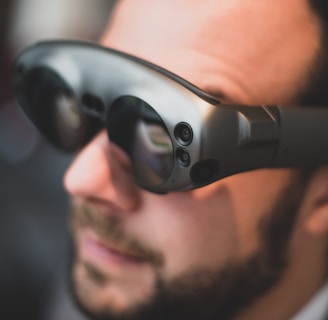
When Google Glass was introduced in 2013, it offered a glimpse of what augmented reality eyewear could become. While this pioneering device ultimately faced challenges in the consumer market, it laid important groundwork for the future of AR glasses. Today, we're witnessing a renaissance in AR eyewear technology that goes far beyond those early efforts.
Current Landscape
The AR glasses market has evolved significantly since Google's initial foray. Companies like Apple, Meta, Microsoft, and numerous startups have invested heavily in developing more sophisticated and consumer-friendly AR eyewear. These modern devices feature improved displays, longer battery life, more powerful processors, and sleeker designs that address many of the shortcomings of first-generation products.
Key Technological Advancements
Several technological breakthroughs are propelling AR glasses forward:
Miniaturization: Components are becoming smaller and more efficient, allowing for more normal-looking eyewear.
Display technology: Waveguide optics and micro-LED displays provide brighter, higher-resolution visuals with wider fields of view.
Computing power: Custom silicon designed specifically for AR applications enables more complex real-time processing.
Spatial awareness: Advanced sensors and cameras provide better environmental mapping and object recognition.
Battery technology: Improved energy efficiency and battery design allow for longer usage times.
Beyond Visual Overlays
The next generation of AR glasses will move beyond simple information overlays to deliver truly immersive and contextual experiences:
Contextual computing: AR glasses will understand what you're looking at and provide relevant information automatically.
Spatial computing: Digital objects will interact with physical environments in more realistic ways.
Multimodal interfaces: Control will extend beyond voice and touch to include gesture recognition and even neural interfaces.
AI integration: Artificial intelligence will power personalized experiences tailored to individual preferences and needs.
Practical Applications
As AR glasses become more sophisticated, their practical applications continue to expand:
Professional use: From surgery to manufacturing, AR glasses are revolutionizing how professionals work by providing hands-free access to information and remote expertise.
Education: Interactive learning experiences can overlay historical contexts, scientific concepts, or language translations onto the real world.
Navigation: Directions and points of interest can be overlaid directly onto your field of vision.
Entertainment: From gaming to watching media, AR glasses offer new ways to blend digital content with physical spaces.
Accessibility: AR glasses can provide visual assistance to those with impairments through features like text magnification or object recognition.
Challenges Ahead
Despite significant progress, several challenges remain:
Social acceptance: AR glasses must overcome the "glasshole" stigma associated with early Google Glass adopters.
Privacy concerns: The ability to record or analyze surroundings raises important questions about consent and data security.
Battery life: Powerful computing in a small form factor continues to present energy challenges.
Price point: Most advanced AR glasses remain prohibitively expensive for mainstream adoption.
The Path Forward
As technology continues to advance, we can expect AR glasses to become increasingly integrated into our daily lives. The future likely holds devices that seamlessly blend with traditional eyewear while providing powerful computing capabilities. Eventually, AR glasses may even replace smartphones as our primary digital interface, creating a world where digital information is naturally integrated with our perception of the physical environment.
The journey that began with Google Glass is far from over. As we move beyond those early prototypes, AR glasses stand poised to fundamentally change how we interact with both digital information and the physical world around us.
Tech
Stay updated with the latest tech innovations.
Gadgets
News
fellipefppms@gmail.com
+19544933295
© 2025. All rights reserved.